
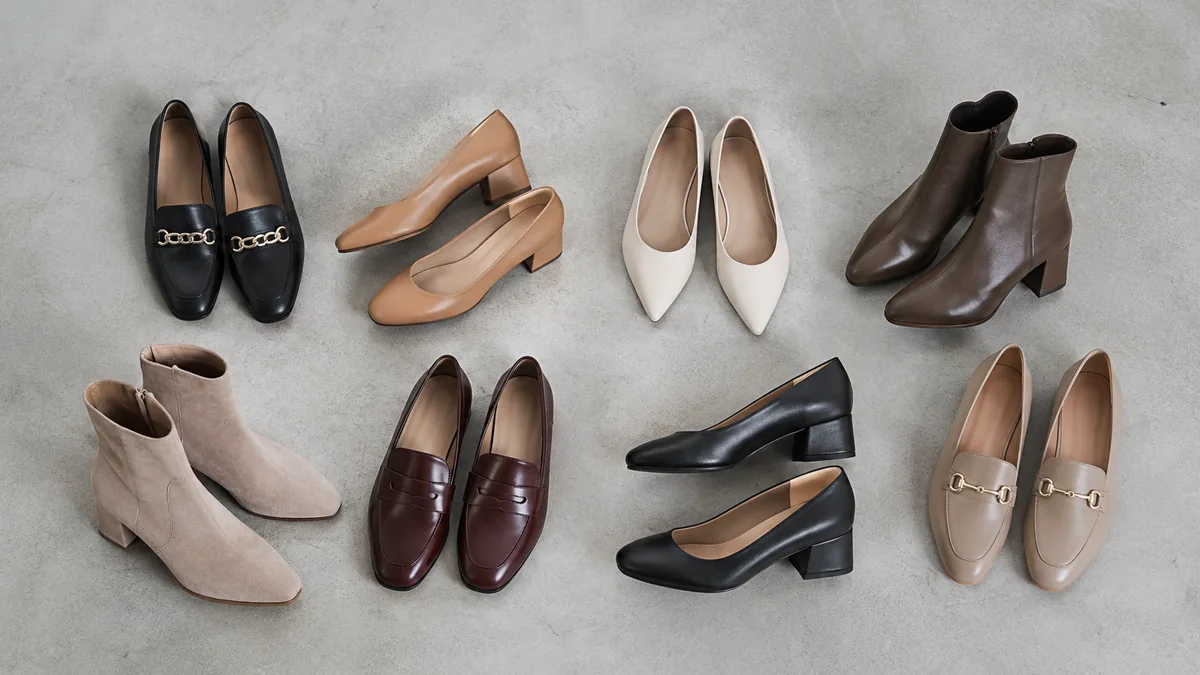
Shoes are where most business casual outfits quietly fall apart. A good blazer and trousers can be undone by worn-out sneakers or beach sandals, and a strong pair of shoes can lift a very simple outfit. The good news is that the rules are easier than people fear. Business casual shoes are closed, clean, structured and comfortable enough to walk in all day.
This guide sorts shoes into three groups: safe everywhere, safe with conditions, and better left for the weekend. For the clothes that go above them, see our complete business casual guide for women.
The short answer: what makes a shoe business casual
Ignore the labels for a moment and look at five features.
- The toe is closed or only lightly open. A closed toe is the safest choice in a conservative office.
- The shape holds its form. Leather, suede and structured fabric look intentional. Flimsy foam does not.
- The sole is slim to moderate. Chunky athletic soles read as gym wear.
- The condition is clean. Scuffed heels, stretched-out toes and dirty laces are noticed more than the style.
- The heel height is walkable. Nobody expects stilts at a desk.
If a pair passes all five, it will almost always work. If it fails two or more, keep it for another setting.
Safe in almost every office
Loafers
The loafer is the workhorse of business casual. A leather or suede loafer with a flat or low block heel works with trousers, ankle-length pants, midi skirts and even tailored shorts in warmer climates. Black, brown and burgundy are the classic colors, and a pair in a muted tan fits nearly everything.
Ballet flats and pointed flats
A pointed-toe flat lengthens the leg line and looks more polished than a rounded ballet flat. Choose a pair with a bit of structure and some arch support. Flats are especially good under cropped trousers where the ankle shows.
Low block heels and kitten heels
A heel between roughly one and two inches is easy to wear and looks dressed up without feeling like an event. Block heels are more stable than stilettos, and a closed pump or slingback in a neutral shade pairs with dresses, skirts and trousers.
Ankle boots
Sleek leather or suede ankle boots are fine for business casual from fall through early spring. Keep the heel modest and the shaft clean. Our guide on how to wear ankle boots covers the shapes that look best with work trousers and skirts.
Safe with conditions
Sneakers
"Are tennis shoes business casual?" is one of the most common questions on this topic, and the honest answer is: it depends on the office and the sneaker. In a relaxed or creative workplace, a minimalist leather sneaker in white, black or cream can work with tailored trousers or a midi skirt. Running shoes, bright athletic styles and anything with thick foam soles generally do not. If you are unsure, check what colleagues wear and read your dress policy. We cover this in more detail in our guide to wearing sneakers.
Open-toe shoes and sandals
Many offices accept open-toe styles, but with limits. A heeled sandal or a polished flat with a structured strap is usually fine in warm weather, while flip-flops and very casual slides are not. Keep your toenails neat, and choose a sandal that looks like a shoe, not a beach accessory. If your workplace is traditional (law, finance, some government roles), closed toes are the safer default.
Boat shoes and espadrilles
Boat shoes can pass in a casual office, and espadrilles with a flat or low wedge can work in summer. Both lean casual, so pair them with crisp tailoring to keep the outfit grounded.
Knit and fabric shoes
Knit flats and sneakers are comfortable, but they can look more like athletic shoes than office shoes. A sleek, dark knit flat with a clean outsole is the best version of this idea. A bright, stretchy sneaker is not.
Better saved for the weekend
- Flip-flops and pool slides
- Platform clogs with heavy wear
- Worn-out canvas shoes
- Stilettos with very high platforms
- Anything noticeably dirty, scuffed or broken
Matching shoes to what you are wearing
With trousers
Loafers, pointed flats, block heels and ankle boots all work. Let the hem decide: a full-length trouser should skim the top of the shoe, while a cropped or ankle-length trouser shows the shoe and looks best with a slim profile.
With skirts and dresses
Pumps, slingbacks, ballet flats and knee-high or ankle boots work well. For a midi skirt, a low-profile loafer or a pointed flat balances the length.
With jeans
If your office allows dark denim, treat it as dressy: loafers, leather ankle boots or block heels. See our wide-leg jeans shoe guide for hem-and-shoe pairings.
With black and white outfits
A monochrome base works with almost any neutral shoe. For ideas, see our black and white work outfits.
Color and material choices that stretch your budget
You do not need a large collection. A small, well-chosen set covers a full work week.
- One black shoe: a loafer or pump that goes with everything dark.
- One neutral shoe: tan, nude, taupe or cream for lighter outfits.
- One boot: an ankle boot in black or brown for cooler months.
- One comfortable flat: for long days and commutes.
Leather and good suede last the longest and can be resoled or repaired. Matching your shoe to your belt or bag is a classic move, but it is not required. A coordinated look can simply share a color family.
Comfort is part of the dress code
An outfit looks best when you can stand and walk in it. Look for cushioned insoles, a stable heel and enough room across the toes. If you commute on foot, carry a comfortable pair and change at your desk. Rotate your shoes so each pair rests a day between wears, which helps them keep their shape.
Care that keeps shoes looking professional
- Wipe leather after wet weather and let shoes dry naturally, away from heaters.
- Use a conditioner on leather every so often to avoid cracking.
- Brush suede and use a protector made for it.
- Replace worn heel tips before they damage the heel itself.
- Use shoe trees or stuffing to hold the shape.
FAQ
Are tennis shoes business casual?
In most traditional offices they are not, especially athletic running shoes. A clean, minimalist leather sneaker may be acceptable in a relaxed workplace, so check your dress policy and what colleagues wear.
What shoes are considered business casual for a woman?
Loafers, ballet and pointed flats, low block heels, pumps, slingbacks and sleek ankle boots are all widely accepted. Choose clean, structured shoes in neutral colors.
Are open-toed shoes business casual?
Often yes, in warm weather and in less conservative offices, if the shoe looks polished, such as a heeled sandal or a structured flat. Avoid flip-flops, and choose closed toes if your workplace is formal.
Are boat shoes business casual?
They can pass in casual offices, especially with tailored pants. They lean relaxed, so pair them with crisp clothing.
What shoes should I wear for business casual?
Start with a black or brown loafer or a pointed flat. Add a low block heel and an ankle boot, and you can dress for most business casual days.