
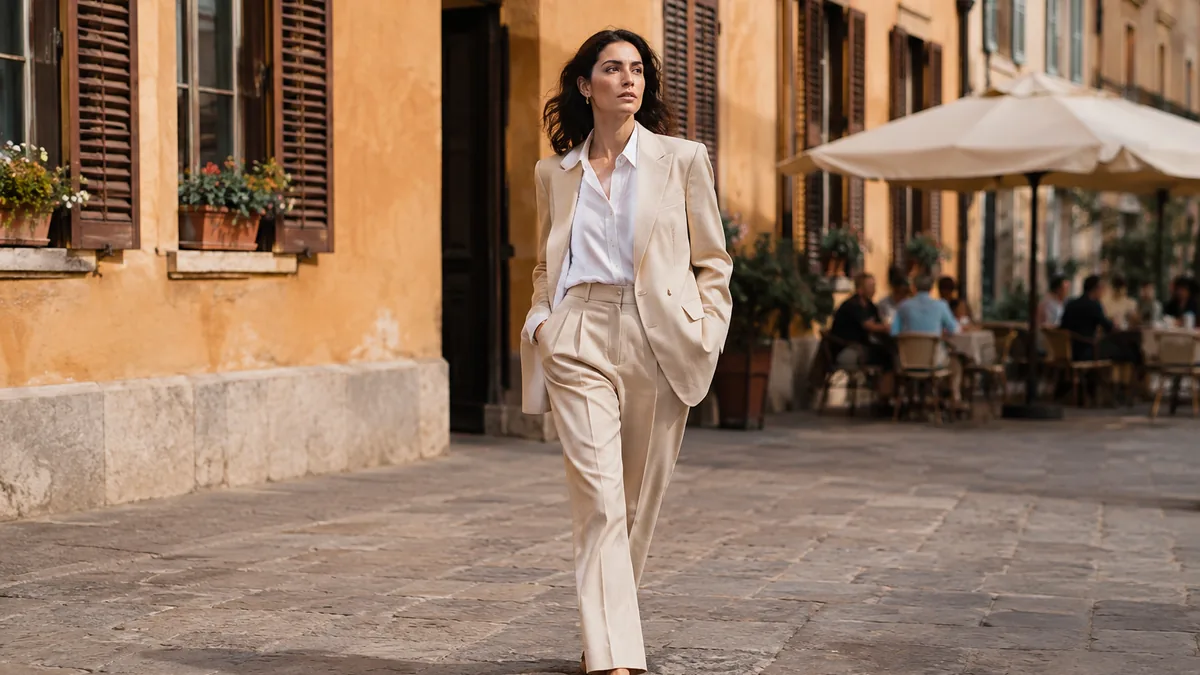
People who visit Milan, Rome or Florence often come home with the same observation: the clothes are not especially loud, but everyone looks put together. Italian style is less about a specific trend and more about a set of habits. This guide turns those habits into clear steps you can follow with clothes you can buy anywhere.
A caution before we begin: generalizing about the clothing of a whole country is never fully accurate. Italy has a huge range of regions, ages and subcultures. What follows describes a widely admired style tendency, not a rule for every Italian woman.
The core idea: fit and quality over quantity
The word most often used to describe Italian dressing is sprezzatura, a sense of studied ease. The outfit looks natural, but it has clearly been considered. In practice, that comes down to three habits.
- Tailoring. Clothes fit well, and many people adjust hems, waists and sleeves.
- Fabric. Natural materials such as wool, silk, cotton, linen and leather are favored when possible.
- Care. Shoes are polished, knitwear is free of pilling, and clothes are pressed.
You can start applying all three without buying a single new item: take your best-fitting pieces to a tailor, brush your shoes and put a shaver on your sweaters.
The palette
Italian wardrobes often rest on a calm base: black, navy, camel, cream, grey, olive and white. Color enters through one piece, such as a red bag, a cobalt knit or a printed scarf, rather than head to toe.
A helpful rule is the two-and-one: two neutrals and one accent in any outfit. For example, camel trousers, a cream knit and a deep red bag.
The building blocks
A tailored blazer
Not oversized and not boxy by default: a blazer that skims the shoulders and ends at the hip. It transforms jeans, and it works with a silk skirt. Our business casual guide has ideas for choosing and wearing one.
Great denim
Straight or slightly flared jeans in a dark or mid wash, fitted well at the waist, and hemmed to the right length. Worn with a crisp shirt, they set the tone for effortless dressing.
The white shirt
A white button-up shirt, ironed, with the collar slightly open and the sleeves rolled. It is one of the most flexible pieces in any wardrobe.
Fine knitwear
A merino or cashmere-blend sweater in a neutral shade, worn alone or draped over the shoulders for a classic gesture.
A trench or a wool coat
Outerwear is an investment piece, and Italian wardrobes often put money here. A camel coat or classic trench will carry you through many winters. See our winter outfit ideas for layering.
A leather bag in a good shape
A structured bag, not necessarily expensive, in black, tan or burgundy that matches several outfits.
Shoes
Shoes matter, and they are visible. Typical choices include leather loafers, pointed flats, low-heeled pumps, ankle boots, minimalist white sneakers and, in summer, leather sandals. In general, shoes are comfortable enough to walk on cobblestones. For boot pairings, see our ankle boots guide.
How Italian women dress in summer
Summer in Italy can be hot, and the style adapts without losing polish.
- Linen: shirts, trousers and shirtdresses in natural linen. Our linen pants guide shows how to wear them.
- Cotton dresses: midi lengths with a flattering cut.
- Silk and viscose: flowing skirts and camisoles.
- Leather sandals and mules: simple, flat and well made.
- Sunglasses: nearly essential, in classic shapes.
- A straw or leather bag: structured and neat.
Beachwear stays at the beach. In cities and many towns, wearing a swimsuit cover-up or very short beach shorts to walk around is generally considered out of place, and some places have rules about covered shoulders in churches. Pack a light scarf or shirt to cover up.
Make-up, hair and accessories
The overall look is usually understated.
- Make-up: a polished base, defined brows and one feature, such as lipstick or eyeliner.
- Hair: healthy and natural, often in a low ponytail, a loose wave or a sleek bob.
- Jewelry: a few meaningful pieces, such as small gold hoops, a watch or a pendant.
- Scarves: silk scarves around the neck, in the hair or tied to a bag.
A simple Italian-inspired capsule
You can recreate the idea with about a dozen pieces.
- A white shirt
- A striped cotton top
- A fine-knit sweater in camel or grey
- Dark straight jeans
- Tailored black or navy trousers
- A midi skirt
- A blazer
- A trench coat
- Leather loafers
- Leather ankle boots
- A structured bag
- A silk scarf
Outfit formulas to try
The daytime city look
Straight jeans, a white shirt, a camel blazer, loafers and a leather tote.
The aperitivo look
Black trousers, a silk blouse, pointed flats and a bold earring.
The weekend look
A striped top, wide trousers, white sneakers and a crossbody bag.
The summer evening look
A linen shirtdress or a midi skirt with a camisole, leather sandals, sunglasses and a light cardigan for after sunset.
Habits worth borrowing
- Wear what you own often. A well-loved piece looks natural.
- Keep it simple. One strong item is enough.
- Dress for the day. Italians often adjust their clothes to the setting and time.
- Walk more. Comfortable shoes make everyday outfits easier.
- Don't chase every trend. Choose a handful that suit you.
Our guide to French style offers a useful comparison, since the two traditions share many ideas about tailoring and restraint but differ in details such as color and styling.
FAQ
How do Italian women dress?
Typically in well-fitted, quality clothes in a neutral palette, with a polished finish and one or two accent pieces. Tailoring and care matter more than trends.
How do Italian women dress in summer?
In linen, cotton and silk, with midi dresses, shirts, simple trousers, leather sandals and sunglasses. Beachwear is kept for the beach.
How do Italian women dress in Italy day to day?
In practice, most outfits are simple: jeans or trousers, a shirt or knit, a blazer or coat, and leather shoes. Fit, fabric and grooming do the work, and clothes are chosen for the setting and the weather.
What colors do Italian women usually wear?
Black, navy, camel, white, cream, grey and olive, often with a single accent color.
How can I dress like Italian women on a budget?
Prioritize fit and take clothes to a tailor, choose natural fabrics where you can, keep the palette neutral and look after your shoes and knitwear. Italy is diverse, though, and this guide describes a popular style, not a rule for every woman.